
Our Services

Service-aware GPs for veterans

Our service-aware GPs understand veterans’ complex health needs and can help you navigate DVA healthcare.

Two Total Veteran Healthcare clinicians speaking together at the Perth clinic

Face-to-face available

Pain management program

CVC, GP care and
mental health support

6 reasons to see a TVH service-aware GP

no 1 icon

Already understands ADF life and culture

Some of our TVH GPs are veterans themselves, while others have experience working on base as civilian GPs supporting ADF members.

no 2 icon

Knows how service affects wellbeing

Our GPs have worked with many patients managing the impact of years of physical load, injury, disrupted sleep, deployment, trauma and transition to civilian life.

no 3 icon

Recognises how health needs overlap

Our GPs understand how chronic conditions, persistent pain and mental health concerns can affect and compound one another.

no 4 icon

Understands DVA healthcare

Our GPs simplify the process of accessing DVA-funded healthcare because they’re familiar with eligibility requirements, DVA-accepted conditions, and the necessary paperwork for DVA claim support.

no 5 icon

Promotes coordinated care

Our GPs develop Coordinated Veterans' Care plans (CVCs) for veterans with chronic conditions.

no 6 icon

Opens the door to the TVH national network

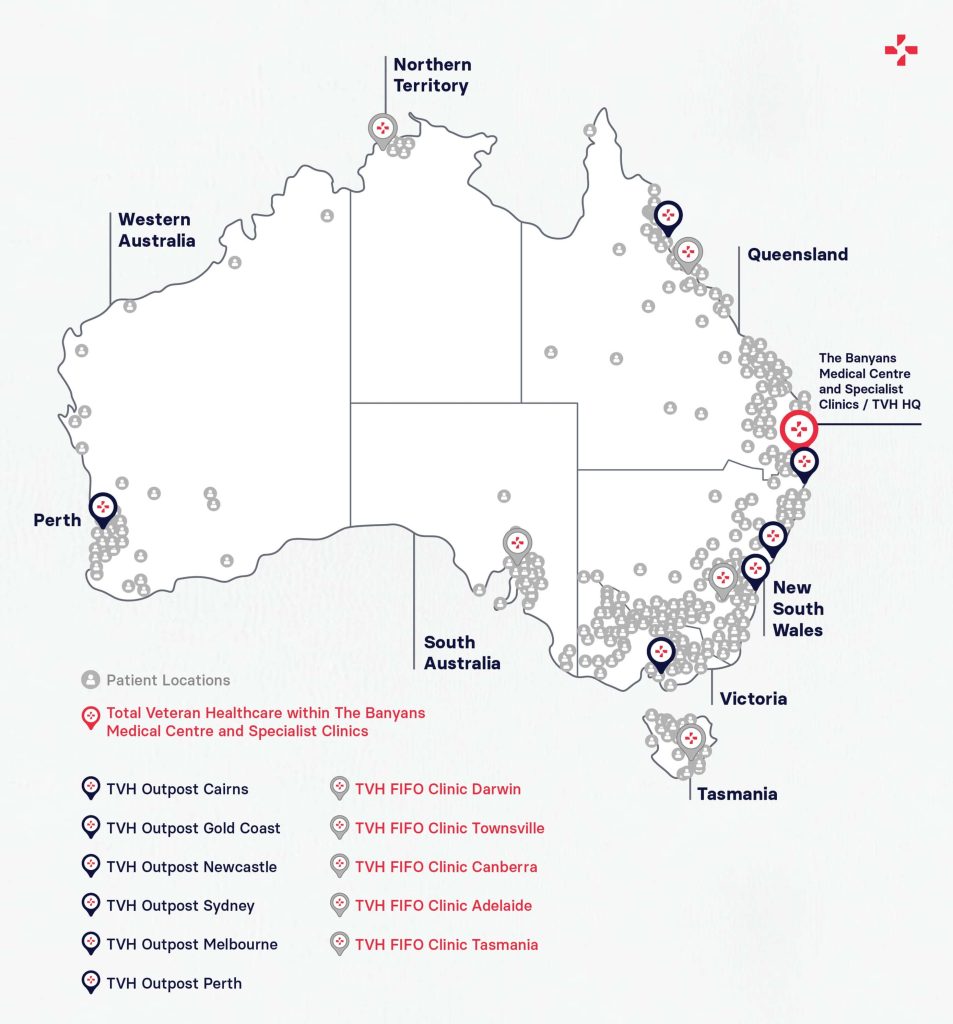
TVH GPs can refer you to our extensive clinical and non-clinical Australia-wide veterans’ care network with more than 20 services available.


What can a service-aware GP help with?

At Total Veteran Healthcare, our service-aware GPs provide general practice care for current and former ADF members, while also helping coordinate the wider care you may need through DVA, allied health and specialist services.

TVH Outpost Newcastle
Your GP can help with:
  • General healthcare and preventative care
  • Chronic disease management
  • Persistent pain and musculoskeletal concerns
  • DVA pain care when conventional treatment has not worked
  • Mental health care
  • Coordinated Veterans’ Care plans
  • DVA-funded allied health referrals
  • RPBS prescriptions and DVA authority prescription applications
  • Medical reports and supporting documentation for DVA claims
  • Referrals to psychiatry and other medical practitioners
  • Coordination across the wider TVH network

Coordinating your care

Health issues tend to intersect. A bad back makes it hard to sleep, which may make you more irritable and forgetful, causing tension in your relationships. You’re seeing a physio, have a psychiatrist involved, and there’s another healthcare appointment coming up.

Your TVH GP has oversight of your care needs, making it easier for you to access the care you need without having to constantly re-explain your situation. They can review what each provider is doing, coordinate referrals and adjust the plan as your needs change.

Our GPs can refer you into the broader TVH provider network, which includes: 

If standard treatment has not helped, they can also consider whether another clinical pathway is appropriate rather than automatically sending you around the same loop again.

DVA healthcare navigation

What DVA funds depends on your card type, your accepted conditions and the treatment you need.
DVA-card

DVA Gold Card treatment

A Gold Card supports veterans whose service has had a significant medical impact, or who were in certain types of service. It can also support dependents of veterans who hold a gold card under their name.

A Gold Card covers clinically necessary healthcare for all medical conditions within Australia. That can include treatment through GPs, medical practitioners and eligible allied health providers. Some services still require a referral or prior approval from DVA.

DVA-card

DVA White Card treatment

A White Card supports veterans with accepted service-related injuries or conditions. The exact treatment covered varies depending on your type and duration of service.

The DVA may not necessarily fund treatment for every health need you have. It covers treatment for “accepted conditions,” meaning injuries or illnesses that DVA has formally recognised for treatment or compensation purposes.

TVH GPs can help establish your eligibility for DVA-funded healthcare.
If you’re not sure what is listed against your card, tell us when you book. We can help you work through the next step.

Easing your load: DVA paperwork help

There’s a lot of paperwork involved with DVA healthcare – referral letters, prescriptions, supporting letters and approvals. TVH’s GPs deal with the DVA all the time and know what’s needed at each stage.

Allied health referrals

Need physio, psychology, podiatry, exercise physiology or another allied health service? For eligible DVA-funded treatment, your GP can issue the appropriate referral and remain involved as treatment progresses.

DVA’s allied health treatment cycle generally allows up to 12 sessions or one year under a referral, whichever comes first. Your allied health provider reports back to your GP before further treatment is considered. That means your GP stays across what is happening rather than simply sending you off with a referral.

RPBS and authority prescriptions

Eligible Veteran Card holders may receive medicines through the Repatriation Pharmaceutical Benefits Scheme (RPBS).

Some medicines can be prescribed routinely. Others need an authority from DVA before they can be supplied under the scheme.

If an authority prescription is clinically appropriate, your TVH doctor can make the relevant application and provide the clinical information DVA requires.

Supporting letters and DVA claims

Your GP may also be able to provide medical information or supporting documentation for a DVA compensation claim, depending on what DVA has requested.

TVH provides dedicated DVA Claim Support for veterans who require more formal medical assessments and reports, including:

  • Provisional Diagnosis
  • Complete Diagnosis
  • Initial Liability assessments
  • Permanent Impairment assessments.
Our team can help establish what stage you are at and what medical information is actually required, rather than ordering reports you may not need.

Accessing a TVH
Service-Aware GP

TVH provides face-to-face GP appointments at our Outposts across Australia, with telehealth appointments available where clinically appropriate.

no 1 icon

Complete our short onboarding form or call us on 07 3523 3991.

no 2 icon

Our onboarding team reviews what you’re looking for.

no 3 icon

We contact you to discuss your needs and organise an appropriate appointment.

no 4 icon

You attend an appointment with a TVH GP, who assesses your needs and works with you on the next steps.

We’re here to help you. Don’t wait any longer.

Frequently asked questions

I have a White Card. What will DVA pay for?

A White Card generally funds treatment for conditions DVA has accepted. Some veterans are also eligible for treatment under Non-Liability Health Care.
If you’re unsure which conditions are covered, your TVH GP can help you work through your current entitlements and treatment requirements.

A Gold Card can fund clinically necessary healthcare for all medical conditions within Australia. Some services still require a referral or prior DVA approval, and the provider must accept DVA arrangements for that treatment.
DVA-funded allied health services generally require an appropriate referral. Your GP can arrange this when the service is clinically appropriate and covered by your DVA entitlement.
Your GP can review the progress information from your allied health provider and determine whether another treatment cycle is clinically required. You do not automatically have to stop treatment simply because the previous cycle has finished.

Yes. Eligible veterans may access medicines through the RPBS. If a medicine requires DVA authority, your doctor can apply for that approval when the prescription is clinically appropriate.

DVA makes the final decision on authority requests.

Ask us. Your GP can check your card type, accepted conditions and the requirements attached to the proposed treatment. Some services need referrals or prior approval before they are funded.

Your GP may be able to provide relevant medical information or supporting documentation, depending on what DVA has requested.

For formal claim assessments and reports, TVH also provides a dedicated DVA Claim Support service.

Yes. Your GP can assess persistent pain, review what you have already tried and coordinate other providers where needed.

If conventional treatment has not provided enough relief, your GP can consider whether another pain management pathway or healthcare review is clinically appropriate.

No. You can contact TVH if you are unsure about your DVA status, funding or where to start.

Our onboarding team can talk through what you are looking for and help identify the right entry point. DVA remains responsible for determining formal eligibility and funding.

Telehealth is available for suitable TVH services across Australia. Some examinations,
assessments or DVA-funded services need to be completed face-to-face. For example, to establish a usual GP status for the DVA, you will need to attend 2 face-to-face sessions every 24 months (or 1 session for regional and rural areas).

Our onboarding team can tell you what applies to your appointment.